
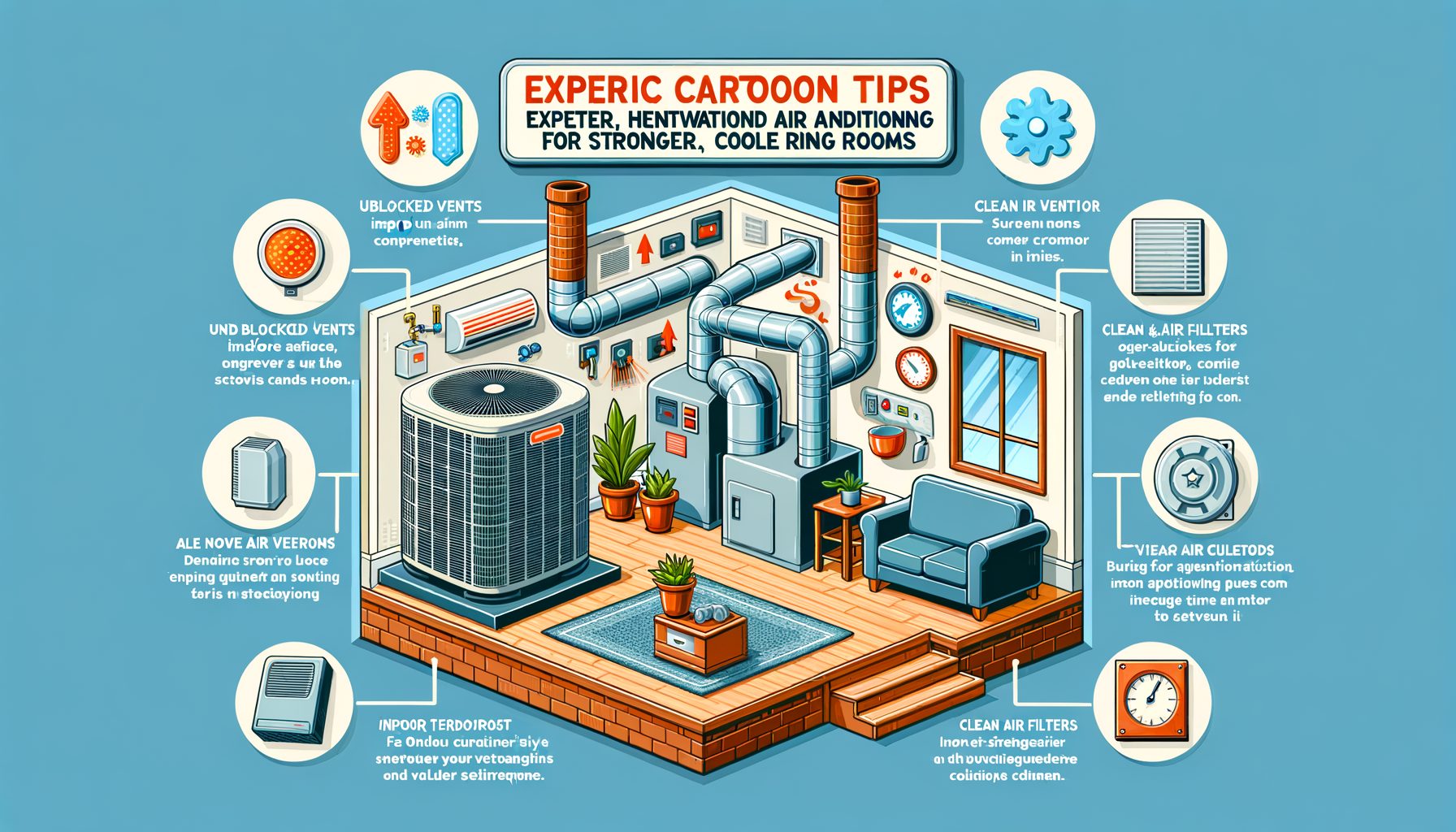
Rooms should feel cool, not barely breezy. When vents whisper instead of whoosh, comfort, energy, and money slip away. Here’s a guide to boosting AC airflow fast—no guesswork. You’ll see why airflow collapses, what you can do today, how ductwork and static pressure quietly choke performance, and when to call a pro. Expect clear steps, real numbers, and trusted references so stronger, cooler rooms arrive the smart way.
Why weak AC airflow happens (and how to spot it fast)
An AC system moves air, plain and simple. The blower typically pushes 350–450 cubic feet per minute (CFM) per ton of cooling through filters, coils, and ducts. Add resistance—static pressure—and CFM drops. With less air, you get uneven cooling, higher humidity, longer run times, and bigger bills. Usual suspects: dirty filters, undersized or leaky ducts, blocked returns, clogged evaporator coils, and poor vent balancing. The upside? Each cause has a clear fix.
Begin with symptoms. One room runs hot while the hallway feels cold? Think airflow imbalances or duct losses. A strong blast at one vent and almost nothing at another often means the weak room’s duct path is long, crushed, or leaking. If the whole home stays muggy even while the AC runs, airflow over the coil may be too low to wring out moisture. Whistling or noisy vents are another early clue—the system may be forcing air through a restriction.
Try a quick return test: hold a thin tissue near the return grille while the fan runs. It should be pulled in easily. A weak tug suggests a blocked return, a dirty filter, or undersized return capacity. Then check the supply registers. You should feel a firm, cool stream; if it’s faint, the filter or coil could be restricted, or static pressure may be elevated by duct issues. Short cycling (frequent on/off) also points to poor airflow or oversized equipment that never stabilizes humidity.
Numbers help. Many techs target roughly an 18–22°F (10–12°C) temperature drop across the coil in humid climates and 15–18°F (8–10°C) in drier regions when airflow is correct. If you’re far outside those ranges, airflow may be off. Precise diagnosis takes instruments, yet these simple checks quickly confirm whether airflow leads your comfort problems.
Quick wins you can do today to boost AC airflow
1) Swap the air filter (or step down from an overly restrictive one). Filters clog fast during pollen or smoke season—the top airflow killer. Using a very high MERV in a system not designed for it? Drop to MERV 8–11 to cut static pressure while still catching most household dust. Mark the calendar to check monthly during heavy use. The U.S. EPA notes that clean filters improve air quality and HVAC performance; learn more at epa.gov/indoor-air-quality-iaq.
2) Open and clear every supply register and return grille. Chairs, rugs, pet beds, and curtains quietly block vents. Don’t close vents to “push air” elsewhere; total airflow usually falls as static pressure rises. Keep at least 12 inches (30 cm) clear in front of grilles, and vacuum dust from the fins.
3) Set the fan wisely. If your thermostat supports scheduling, run the fan in “Auto” during cooling for best dehumidification and use short circulation cycles when rooms feel stale. Some smart thermostats gently circulate air between cooling cycles. The U.S. Department of Energy offers guidance on smart controls at energy.gov/energysaver.
4) Reduce indoor humidity sources. High humidity makes air feel warmer and extends run time. Use bathroom/kitchen exhaust, fix drips, and run a dehumidifier if needed. At 40–55% RH, rooms feel cooler at the same temperature, easing the load.
5) Check outdoor unit clearance. Split systems need at least 24 inches (60 cm) of open space on all sides of the condenser. Trim shrubs, remove leaves, and rinse gently from the top outward. While the effect is mainly on heat rejection, maintaining capacity helps the blower avoid long, unproductive runs.
6) Provide a return path from closed rooms. Air supplied to bedrooms must make it back to the air handler. If a bedroom door seals tight and there’s no dedicated return or jumper duct, pressure builds and chokes flow. Ensure a 3/4-inch (2 cm) door undercut or add a transfer grille. That simple change often restores bedroom airflow without touching the equipment.
7) Coil cleaning, light version. If you can safely view the indoor evaporator coil without removing sealed panels, look for lint or a dust mat. Even a thin layer reduces heat transfer and airflow. See dirt? Schedule a professional coil cleaning; DIY chemicals can damage fins. ENERGY STAR’s maintenance tips are a good reference: energystar.gov/campaign/heating_cooling.
Go deeper: ducts, static pressure, and balancing (where big gains hide)
Even with spotless filters and open vents, the duct system can bottleneck airflow. Field studies from national labs and utility programs show many homes lose 10–30% of conditioned air through leaks or poorly sized ducts. Undersized returns, long flex runs with tight bends, crushed sections, and unsealed joints all add friction. The outcome is high external static pressure: the blower works harder yet moves less air.
Use a practical sequence. First, seal obvious leaks. Apply mastic or UL-181 tape to accessible joints in attics, basements, or closets. Focus on returns—they’re often the worst offenders. Next, straighten and shorten flexible duct where possible. Gentle sweeps beat sharp turns. Then this: insulate ducts in unconditioned spaces to protect temperature and prevent condensation. For design-level fixes, pros rely on ACCA Manual D for sizing and balancing; see acca.org/standards.
Balancing matters as well. Partially close dampers on “too-cold” rooms to nudge air toward weak rooms, but make changes in small steps to avoid bumping system pressure too high. Aim for even, noticeable flow at every register, not a fire hose at a few. What’s interesting too, if your system has an ECM (variable-speed) blower, some compensation happens automatically, yet lowering system resistance still improves comfort and efficiency. ASHRAE and ACCA commonly use about 400 CFM per ton as a design baseline; real homes often land between 350 and 450 CFM/ton.
Use the table below as a quick guide to typical airflow killers and their impact:
| Cause | What it does | Simple test | Estimated impact |
|---|---|---|---|
| Clogged filter (or too-high MERV) | Raises static pressure, slashes CFM | Replace/downgrade filter; check vent force | 10–30% airflow loss |
| Leaky return duct | Pulls hot/dirty air, starves coil | Tissue test at return; inspect joints | 5–25% capacity loss |
| Crushed or long flex runs | High friction, low room CFM | Trace weak room’s duct; look for kinks | 5–20% airflow loss to that room |
| Dirty evaporator coil | Blocks airflow and heat transfer | Visual check; pro coil cleaning | 10–40% performance drop |
| Closed/blocked registers | Increases pressure, reduces total flow | Clear 12+ inches in front; open vanes | 5–15% system-wide loss |
If you want data, ask a technician to measure total external static pressure and delivered CFM. A reading above the manufacturer spec (often 0.5 in. w.c. for many residential units) flags restriction. Remedies may include adding a return, upsizing a filter rack, or reworking bottleneck ducts. Well-targeted upgrades here often deliver the single biggest comfort improvement per dollar.
Smart settings, maintenance routines, and when to call a pro
Start with settings. Keep cooling setpoints steady; big swings extend recovery times and can demand high airflow through restrictive ducts. If you have a variable-speed blower, enable comfort or dehumidification modes in the installer menu to tune airflow for your climate. In humid regions, higher blower speeds can reduce dehumidification; a slight speed reduction (done by a pro) may improve moisture removal without hurting comfort.
Maintenance rhythms preserve airflow. Replace filters on schedule, clean supply and return grilles, and book annual service that includes coil cleaning, condensate treatment, and static pressure checks. A pro can also verify that blower speed taps or ECM profiles match your duct system. Many homes run factory defaults that ignore real-world resistance. Correcting blower speed can instantly add noticeable vent force.
Know the DIY/pro line. Call a qualified HVAC technician if: 1) you suspect a dirty or frozen evaporator coil; 2) humidity stays above ~60% despite long run times; 3) you hear duct “oil canning” or whistling; 4) rooms remain hot after filter and vent fixes; or 5) you see ice on refrigerant lines. Issues like these often point to airflow restrictions, low refrigerant charge, or both—and require instruments for safe diagnosis.
Think through upgrades. When ducts are sound but performance lags, consider changes that directly reduce resistance: a larger return, a media filter cabinet with a deeper (4–5 inch) filter for lower pressure drop, or a variable-speed air handler. For aging systems, a right-sized, high-efficiency unit paired with duct sealing can trim energy use 10–20% while boosting comfort, according to ENERGY STAR and utility program data. Always pair equipment upgrades with duct evaluation; new gear on bad ducts just means new problems on old bottlenecks.
For standards and best practices, see ACCA (acca.org), ENERGY STAR (energystar.gov), and DOE Energy Saver (energy.gov/energysaver). Using their guidance keeps your fixes aligned with proven methods, not myths.
FAQ: AC airflow, comfort, and efficiency
Q: How much airflow should my AC deliver? A: Many residential systems are designed around 350–450 CFM per ton of cooling. The exact target depends on your climate and equipment. Humid regions sometimes run a bit lower to improve dehumidification, while dry climates tolerate higher airflow for stronger sensible cooling. A pro can measure CFM and static pressure to confirm where you stand.
Q: Is a higher MERV filter always better? A: Not if the system wasn’t built for it. Very high-MERV filters can increase resistance and starve the blower, especially in 1-inch slots. A better approach is a deep media cabinet (4–5 inches) that delivers high filtration with low pressure drop. For most homes, MERV 8–11 balances cleanliness and airflow well. Check manufacturer specs or ask a technician.
Q: Can I close vents in unused rooms to push air elsewhere? A: It rarely works. Closing vents raises duct pressure and often reduces total system airflow. The result can be coil icing, noise, and higher energy use. If zoning is needed, consider a professionally designed zoning system or strategic duct balancing, not a register-shutting campaign.
Q: How do I know if ducts are the problem? A: Watch for rooms far from the air handler that stay hot or cold, flex ducts with sharp bends, or returns much smaller than supply trunks. Whistling and dust streaks on seams point to leaks. A duct blaster or pressure test by a pro can quantify leakage and highlight the worst sections for sealing.
Q: What’s the simplest test I can do today? A: Replace the filter, open and clear all vents, and perform the tissue test at returns. If airflow improves immediately, a restriction was the culprit. If not, check outdoor clearances and listen for unusual blower sounds. Persistent weak flow after these steps points to coil, duct, or blower settings that merit professional attention.
Conclusion: get stronger, cooler rooms—starting now
Here’s the bottom line. Strong AC airflow depends on a clear path: clean filter, open returns, clean coil, and low-resistance ducts. When any link constricts, static pressure rises and comfort falls. You learned quick, no-risk wins (filter changes, open grilles, door undercuts, humidity control), deeper corrections with big gains (duct sealing, flex straightening, added returns, proper insulation), and the settings and maintenance that keep performance high. You also saw how to decide when it’s time to call a pro for static pressure, coil, or refrigerant diagnostics.
Act today: 1) swap in a clean, appropriately rated filter; 2) clear and open every grille; 3) check door undercuts and add a transfer path if needed; 4) inspect accessible ducts for kinks or leaks and seal with mastic; 5) schedule maintenance that includes coil cleaning and a static pressure check. Well, here it is: those steps alone often turn “barely breezy” into confidently cool rooms while trimming energy waste.
Planning upgrades? Prioritize low-pressure-drop filtration and right-sized returns, then consider variable-speed equipment paired with sealed and balanced ducts. Done right, the strategy protects comfort and efficiency for years. Refer to trusted resources—ENERGY STAR, DOE Energy Saver, ACCA—for standards-based decisions, not trial and error.
Your home can feel cooler and more even by next weekend. Start with the simplest fixes, measure the difference with your senses (and your electric bill), and build from there. Ready to breathe easier? Pick one action from this guide and do it today. What small change will you try first—the filter, the returns, or the duct check? Stronger air, cooler rooms, and lower costs are within reach.
Sources and further reading:
ENERGY STAR: Heating & Cooling
U.S. Department of Energy: Energy Saver